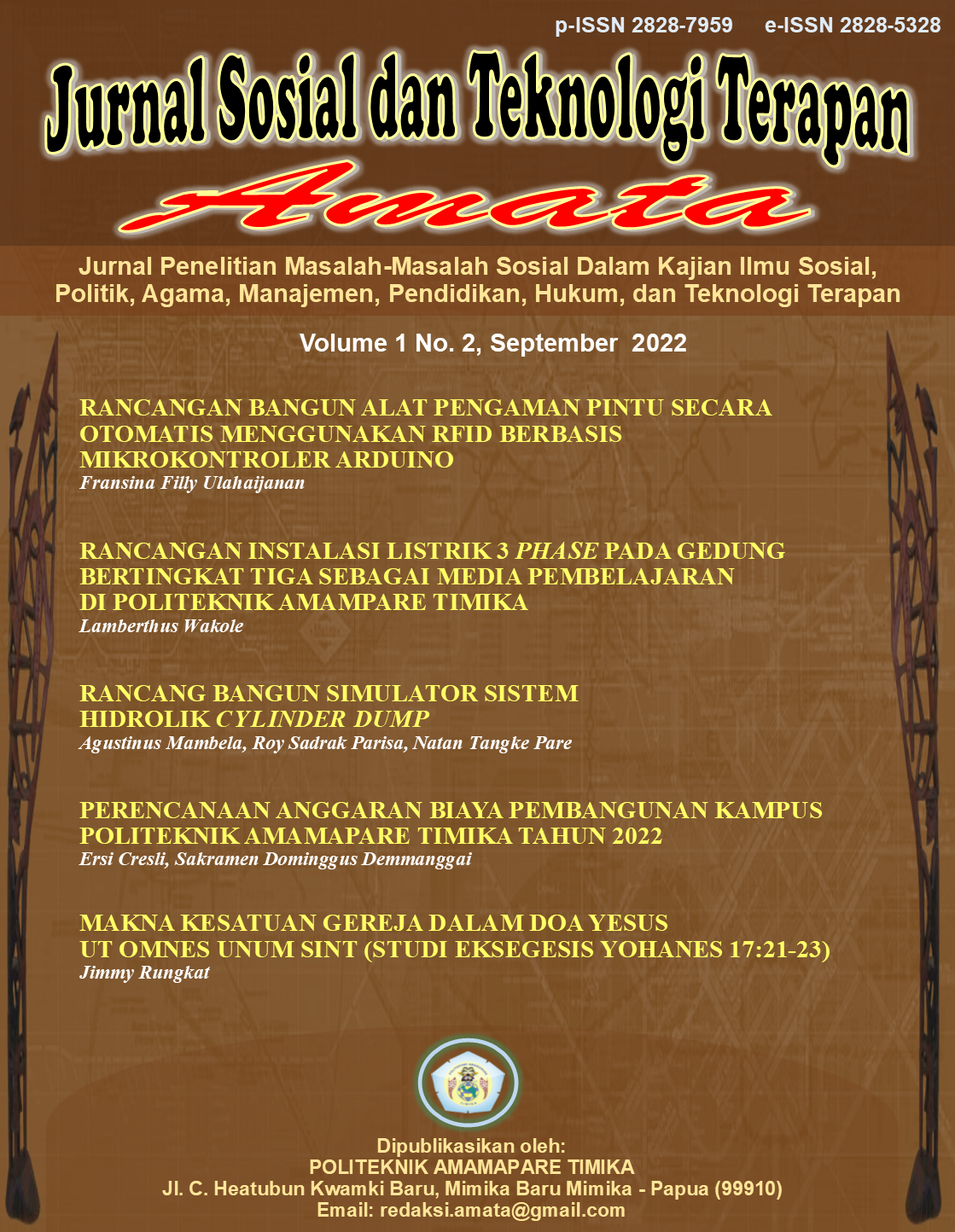
RANCANG BANGUN ALAT PENGAMAN PINTU SECARA OTOMATIS MENGGUNAKAN RFID BERBASIS MIKROKONTROLER ARDUINO
DOI:
https://doi.org/10.55334/sostek.v1i2.289Keywords:
Arduino Uno, RFID reader, SolenoidAbstract
Sistem pengunci pintu saat ini masih menggunakan kunci konvensional, sehingga kurang efisien untuk rumah dengan banyak pintu karena terlalu banyak kunci yang harus dibawa, selain itu kunci konvensional mudah dibuka oleh pencuri. Sehingga diperlukan kunci yang lebih praktis dan efisien, dari masalah tersebut penulis mempunyai gagasan untuk menghasilkan alat pengaman pintu yang aman dan praktis berbasis RFID dengan memanfaatkan RFID tag sebagai pengaman pintu rumah. Rancang bangun pengaman pintu menggunakan mikrokontroler ATmega328 sebagai pengendali rangkaian. dapat disimpulkan bahwa simulasi alat pengaman pintu dapat beroperasi dengan baik, sesuai rancangan yang dibuat. RFID reader yang digunakan memiliki frekuensi 13,56 MHz yang diletakkan dalam box dengan tebal 1,5 mm untuk membaca ID RFID. Solenoid dapat membuka pengunci pintu apabila ID E-KTP sesuai dengan memori mikrokontroler Arduino Uno.
Downloads
References
Astono, R. 2006. Implementasi Dan Perancangan Kunci Pintu Hotel Dengan Radio Frequency Identification (RFID). Skripsi. Program Studi Pendidikan Teknik Elektro Universitas Negeri Semarang. Semarang.
Djuandi, F. 2011. Pengenalan Arduino. www.tobuku.com. 27 Agustus 2015 (20:57).
Gabriel, A. K. Dan O. K. Boyinbode. 2011. The Place of Emerging RFID Technology in National Security and Development. International Journal of Smart Home 5(2): 37-43.
Istiyanto, J. E. 2014.
Kadir. 2012. Panduan Praktis Mempelajari Aplikasi Mikrokontroler dan Pemrogramannya Menggunakan Arduino. Edisi 1. Andi Offset. Yogyakarta.
Pratama, H. S. 2014. RFID Sebagai Pengaman Pintu Laboratorium Jurusan Teknik Elektro Fakultas Teknik Universitas Negeri Semarang.
Suyoko, D. 2012. Alat Pengaman Pintu Rumah Menggunakan RFID (Radio Frequency Identification) 125KHz Berbasis Mikrokontroler ATmega328. Skripsi. Program Studi Teknik Elektronika Universitas Negeri Yogyakarta.
Syahwil, M. 2013. Panduan Mudah Simulasi dan Praktek Mikrokontroler Arduino. Edisi Pertama. Andi Offset. Yogyakarta.
Downloads
Published
Issue
Section
License

This work is licensed under a Creative Commons Attribution-ShareAlike 4.0 International License.
Copyright and Licensing
Authors who publish their work in the Jurnal Sosial dan Teknologi Terapan AMATA agree to the following terms:
The Creative Commons Attribution-ShareAlike 4.0 International (CC BY-SA 4.0) license permits anyone to copy, distribute, display, and create derivative works from the original work, including for commercial purposes, provided that the following requirements of the Creative Commons Attribution-ShareAlike 4.0 license are observed:
Key License Terms
- Attribution (BY):
- Users must give appropriate credit to the original copyright holder/author.
- Users must provide a link to the license.
- Users must indicate whether any changes or modifications have been made to the original work.
- ShareAlike (SA):
- If users remix, transform, modify, or create derivative works from the original material, the resulting work must be licensed under the same or a compatible license (CC BY-SA 4.0).
- No Additional Restrictions:
- Users may not impose additional legal or technological restrictions that prevent others from exercising the rights permitted by this license.
What the Public May Do
- Share: Copy and redistribute the material in any format or medium.
- Adapt: Remix, transform, adapt, and create derivative works for any purpose, including commercial purposes.
Note: The copyright holder retains ownership of the original work. This license only grants the public permission to use the work subject to the terms and conditions specified above.