Desain Smart Switching System Pengisian Baterai Dual-Source Kinetic Energy Recovery Dan Grid Kendaraan Listrik Ringan Dengan ESP32 Pada Wokwi
DOI:
https://doi.org/10.55334/sostekam.v5i2.03Keywords:
Smart Switching System; Dual-Source Charging; ESP32; Kinetic Energy Recovery; Wokwi SimulationAbstract
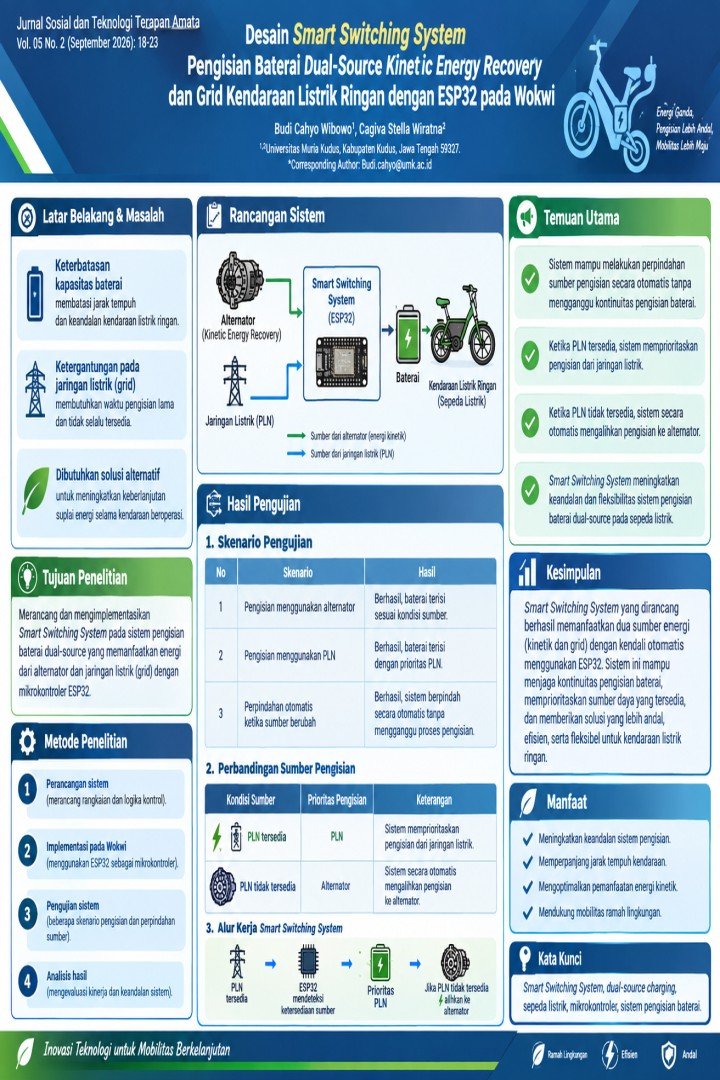
Light electric vehicles, particularly electric bicycles, still face challenges related to limited battery capacity and dependence on grid-based charging. Kinetic energy recovery using an alternator can serve as an auxiliary energy source; however, an appropriate control mechanism is required to ensure safe and automatic transitions between charging sources without interrupting the battery charging process. This study aims to design and implement a Smart Switching System for a dual-source battery charging system utilizing an alternator and the electrical grid. The proposed system employs a microcontroller as the main controller to manage the charging source transition based on the availability of each energy source. Experimental evaluation was conducted under several operating scenarios, including charging from the alternator, charging from the grid, and automatic source switching when the charging conditions changed. The results demonstrate that the proposed system successfully performs automatic charging source transitions without interrupting the battery charging process. When the grid power is available, the system prioritizes grid-based charging; otherwise, it automatically switches to the alternator as the charging source. The proposed Smart Switching System improves the reliability and flexibility of dual-source battery charging for electric bicycles.
Downloads
References
Budianto, W. C., Muladi, M., & Wirawan, I. M. (2023). Sistem pengisian baterai sepeda listrik berbasis Internet of Things (IoT). Emitor: Jurnal Teknik Elektro. DOI: https://doi.org/10.23917/emitor.v1i1.21772
Dilla, B., Widi, B., Wilyanti, S., Jaenul, A., Antono, Z. M., & Pangestu, A. (2022). Implementasi solar charge controller untuk pengisian baterai dengan menggunakan sumber energi hybrid pada sepeda motor listrik. Jurnal Edukasi Elektro, 6(2). https://doi.org/10.21831/jee.v6i2.53327 DOI: https://doi.org/10.21831/jee.v6i2.53327
Ilman, A. F., Humaira, F. M., Dzulkiflih, D., & Mawardi, I. (2020). Hybrid charging system management with automatic switching method. Journal on Advanced Research in Electrical Engineering, 4(2). DOI: https://doi.org/10.12962/j25796216.v4.i2.117
Ismail, N. (2023). Perancangan dan pembuatan sepeda listrik pengisian daya otomatis dengan menggunakan motor DC sebagai sumber energi alternator. Electrical Network Systems and Sources (ENTRIES), 3(1). DOI: https://doi.org/10.58466/entries.v3i1.1509
Ma'sum, M. A., Wardani, N. W., & Silaen, D. H. (2024). Design of a charging system using an alternator to support the performance of the regenerative brake system in electric vehicle. International Journal of Information System and Computer Science (IJISCS).
Prianto, E. (2017). Pengembangan solar panel dan inverter sebagai alat untuk charging baterai pada sepeda listrik. Jurnal Edukasi Elektro, 1(2). https://doi.org/10.21831/jee.v1i2.17419 DOI: https://doi.org/10.21831/jee.v1i2.17419
Prianto, E., Yuniarti, N., & Nugroho, D. C. (2020). Boost-converter sebagai alat pengisian baterai pada sepeda listrik secara otomatis. Jurnal Edukasi Elektro, 4(1). https://doi.org/10.21831/jee.v4i1.32632 DOI: https://doi.org/10.21831/jee.v4i1.32632
Downloads
Published
Issue
Section
License
Copyright (c) 2026 Budi Cahyo Wibowo, Cagiva Stella Wiratna (Author)

This work is licensed under a Creative Commons Attribution-ShareAlike 4.0 International License.
Copyright and Licensing
Authors who publish their work in the Jurnal Sosial dan Teknologi Terapan AMATA agree to the following terms:
The Creative Commons Attribution-ShareAlike 4.0 International (CC BY-SA 4.0) license permits anyone to copy, distribute, display, and create derivative works from the original work, including for commercial purposes, provided that the following requirements of the Creative Commons Attribution-ShareAlike 4.0 license are observed:
Key License Terms
- Attribution (BY):
- Users must give appropriate credit to the original copyright holder/author.
- Users must provide a link to the license.
- Users must indicate whether any changes or modifications have been made to the original work.
- ShareAlike (SA):
- If users remix, transform, modify, or create derivative works from the original material, the resulting work must be licensed under the same or a compatible license (CC BY-SA 4.0).
- No Additional Restrictions:
- Users may not impose additional legal or technological restrictions that prevent others from exercising the rights permitted by this license.
What the Public May Do
- Share: Copy and redistribute the material in any format or medium.
- Adapt: Remix, transform, adapt, and create derivative works for any purpose, including commercial purposes.
Note: The copyright holder retains ownership of the original work. This license only grants the public permission to use the work subject to the terms and conditions specified above.