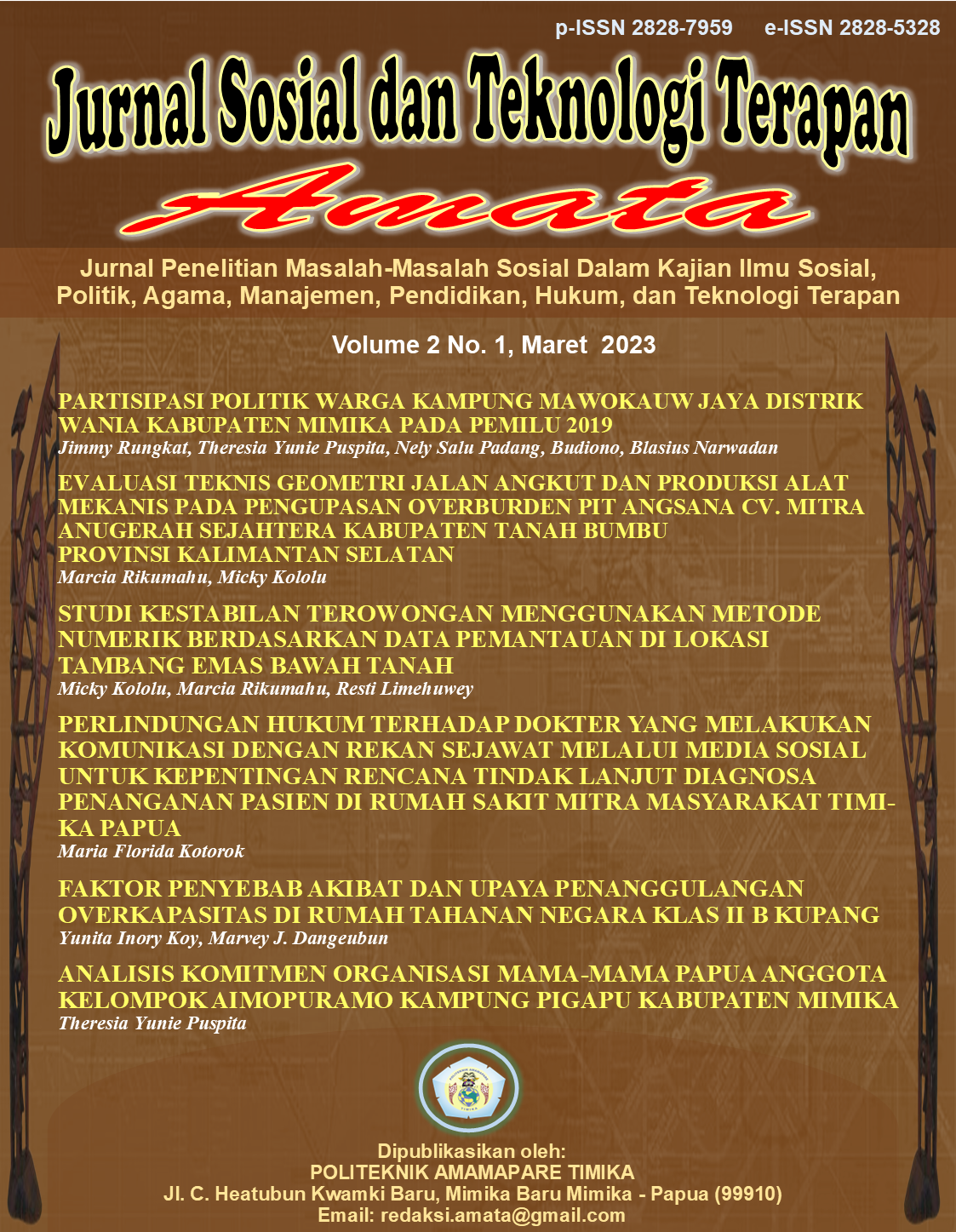
Analisis Komitmen Organisasi Mama-Mama Papua Anggota Kelompok Aimopuramo Kampung Pigapu Kabupaten Mimika
DOI:
https://doi.org/10.55334/sostek.v2i1.74Keywords:
Komitmen Organisasi, Mama-Mama Papua, Kabupaten Mimika, Kelompok AimopuramoAbstract
Penelitian ini bertujuan untuk menganalisis komitmen organisasi mama-mama Papua di dalam kelompok Aimopuramo kampung Pigapu Kabupaten Mimika. Dengan menggunakan metode kualitatif melalui teknik pengumpulan data trianggulasi sumber ditemukan hasil bahwa mama-mama Papua di kelompok Aimopuramo memiliki komitmen organisasi afektif yang rendah, komitmen organisasi normative yang tinggi, dan komitmen organisasi continuity yang masih rendah. Anggota dengan komitmen organisasi normative yang tinggi akan tetap bertahan dalam organisasi karena merasa harus melakukan kewajiban yang sudah menjadi tanggung jawabnya atas hak yang telah di berikan oleh organisasi. Anggota akan bertindak sesuai dengan tujuan dan keinginan organisasi, yang merupakan balasan anggota atas hak yang telah diterimanya dari kelompok. Hal ini dikarenakan komitmen organisasi normative didasarkan pada pendekatan obligation yaitu komitmen secagai tekanan normative yang diinternalisasikan kepada anggota agar anggota bertindak sesuai dengan visi, misi dan tujuan dari organisasi.
Downloads
References
Abouraia, M. K., & Saad M. Othman. 2017. Transformational Leadership, Job Satisfaction, Organizational Commitment and Turnover Intentions: The Direct Effects among Bank Representatives. American Journal of Industrial and Business Management, Vol 7, No 4.
Allen & Meyer. (1990). The measurement and antecedents of affective, continuance and normative commitment to the organization. Journal of Occupational Psychology. 63, 1-18.
Appelbaum, e., Bailey, T., Berg, P., Et al. (2000). Manufacturing Advantage: Why High Performance Systems Pay Off. Cornell University Press, Ithaca, NY.
Basrowi. 2014. Kewirausahaan Untuk Perguruan Tinggi. Bogor : Ghalia Indonesia.
McShane, S. L., & Von Glinow, M. A. (2010). Organizational Behavior: Emerging Knowledge and Practice for The Real World (5th ed.). New York: The McGraw-Hill Companies, Inc.
Suryani Irma, Factors Affecting Organizational Commitment. JMI Vol 9 (1) 2018: 26-34.
Greenberg, Jerald dan Robert A. Baron. 2003. Behavior in Organization. Prentice Hall. New Jersey.
Susanti, & Palupiningdyah. (2016). Pengaruh Kepuasan Kerja dan Komitmen Organisasi Terhadap Kinerja Karyawan Dengan Turnover Intention Sebagai Variabel Intervening. Manajemen Analysis Journal, 5(1), 77-86.
Puspita, Theresia Y. (2020). Pengaruh Persepsi Karakteristik Pekerjaan dan Dukungan Organiasasi Terhadap OCB dengan Mediasi Komitmen Pertumbuhan dan Normatif Karyawan. Jurnal Ilmiah Infokam, Vol 16, No 1.
Robbins, Stephen P. dan Timothy A. Judge. 2018. Perilaku Organisasi. Organizational Behavior (Buku 1, Edisi Ke-12). Jakarta: Salemba Empat.
Sugiyono. 2012. Metode Penelitian Kombinasi (Mixed Methods). Bandung: CV Alfabeta.
Sumber Internet:
https://www.djkn.kemenkeu.go.id/artikel/baca/13317/UMKM-Bangkit-Ekonomi-Indonesia-Terungkit.html
Downloads
Published
Issue
Section
License

This work is licensed under a Creative Commons Attribution-ShareAlike 4.0 International License.
Copyright and Licensing
Authors who publish their work in the Jurnal Sosial dan Teknologi Terapan AMATA agree to the following terms:
The Creative Commons Attribution-ShareAlike 4.0 International (CC BY-SA 4.0) license permits anyone to copy, distribute, display, and create derivative works from the original work, including for commercial purposes, provided that the following requirements of the Creative Commons Attribution-ShareAlike 4.0 license are observed:
Key License Terms
- Attribution (BY):
- Users must give appropriate credit to the original copyright holder/author.
- Users must provide a link to the license.
- Users must indicate whether any changes or modifications have been made to the original work.
- ShareAlike (SA):
- If users remix, transform, modify, or create derivative works from the original material, the resulting work must be licensed under the same or a compatible license (CC BY-SA 4.0).
- No Additional Restrictions:
- Users may not impose additional legal or technological restrictions that prevent others from exercising the rights permitted by this license.
What the Public May Do
- Share: Copy and redistribute the material in any format or medium.
- Adapt: Remix, transform, adapt, and create derivative works for any purpose, including commercial purposes.
Note: The copyright holder retains ownership of the original work. This license only grants the public permission to use the work subject to the terms and conditions specified above.